
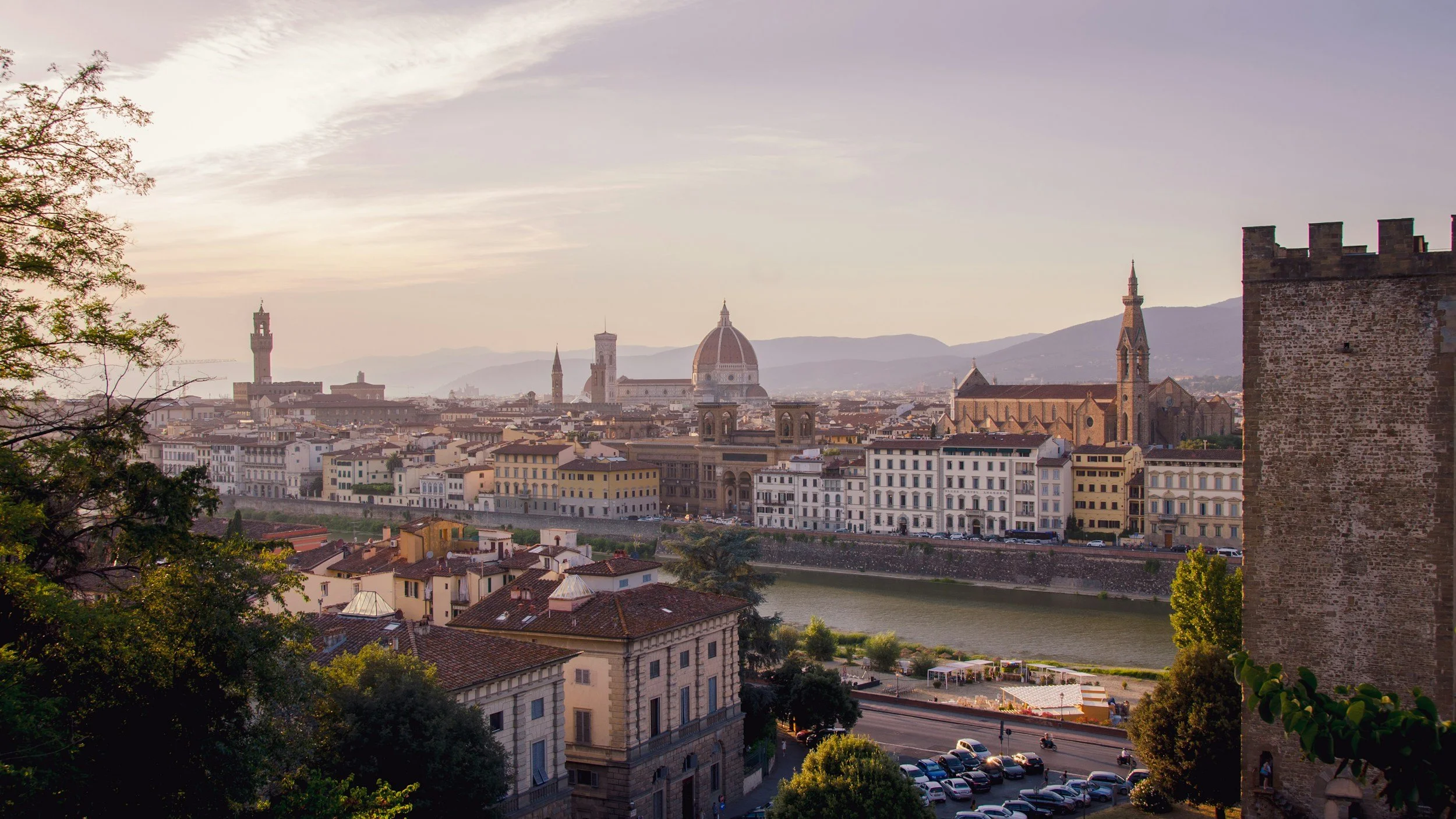
Touring Tuscany and Beyond, 21-28 Days
Welcome
If you have been with us before --- welcome back. We always welcome independent senior travelers seeking new adventures. If you are new to Independent Travel for Seniors then --- welcome.
Some tours almost write themselves, such as The Tale of Two Cities tour of Paris and London. Tuscany, however, will be a tougher nut to crack. Tuscany is about the size of New Jersey and that is probably as far as any similarities go between Tuscany and New Jersey. No one, I repeat, no one tours Newark, Jersey City, or Camden, and though some sad people might go to Atlantic City, and while Ocean City and Cape May remain regional attractions, New Jersey is not a tourist Mecca.
That brings us back to Tuscany.
The rich and vibrant culture of Tuscany extends back more than 3,000 years to the Etruscans and beyond. Before Rome was Rome there was Tuscany. To me the special characteristic of the Etruscans, the one that I most admire, was their life affirming belief in the life well lived. Unlike so many past and current cultures they were less concerned with war and conquest and more with beauty and the meaningful life.
Deed and I have traveled much in our 62 years together and we have seen the world change before our eyes. We have seen Germany rebuilt and London become a foreign city to the English, and Ireland become modern, but somehow Tuscany is still Tuscany although vacation rentals are slowly eating away even the spirit that once gave flavor to its timeless villages. For example, the beautiful town of San Gimignano has lost its authenticity as it is now overwhelmed by tourists who meet only other tourists. Is it still worth a visit? Yes. But we have not recommended it for this trip.
But remember our recommendations are just that --- recommendations. You are an independent traveler. This is your trip.
Etruria: The Origins of Tuscany
Etruria, the ancient home of the Etruscans, covered much of what is now the central part of Italy. Etruria consisted of a number of independent city-states and was less a bordered country than a cultural region unified by language, religion and shared values. It was the foundation for what would become the Roman Republic/ Empire. The various city-states shared much in common and were often bound by a mutual culture boosted by trade and diplomatic alliances.
In the 7th-5th centuries BC the Etruscan influence ran from Milan to Naples.
TIP! It would greatly enrich your travel experience if you would take some time to brush up on Etruscan art and architectural achievements and even toss in a bit of Etruscan history before you leave home.
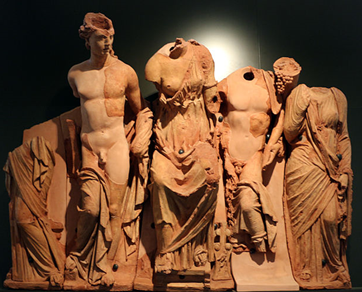
Etruria and the Etruscans transitioned into Roman identity, and after the Middle Ages (c. 700–1200 AD), Tuscany emerged as the center of the Renaissance (1200–1600). It was in Tuscany that “Man became the meaning of all things” and that theme was best expressed in Michelangelo’s David.
It is to the Tuscany of the Renaissance that we now turn. The culture will unfold slowly as you gently move from one city to the next. From its Etruscan and Roman roots great cities appeared supporting governments, trade, and the rise of universities.
I often think of the Renaissance as a rose that began to blossom around the 11th century reaching its glorious perfection in the late 1500’s, and then like any rose, it all too rapidly lost its bloom and fragrance.
Preparing an Itinerary
Our tour suggestions for your itinerary are just that --- they are suggestions. Almost always they’re places we have visited time and again, and we put into the equation that sometimes the places we now recommend are places we visited when we were young puppies. Now, I’m an ol’ hound dog. Note: Deed suggested that I slip back to first person in all references to “ol’ hound dogs.”
Again I digress. I’ll try to stay focused
We recommend that you fly in and out of Milan’s Malpensa Airport (MXP). From our experiences MXP is a user-friendly airport and the car rentals are convenient. Once you’re through passport control secure your luggage and follow signs to car rental desks (likely in Terminal 1). Show the rental agent your reservation contract, valid driver’s license, passport, and credit card.
TIP! Italians often ask for an International Driving Permit which is easy to get at home before you leave. So far we have NEVER been asked for an IDP.
Always inspect the car and take pictures with the agent next to the car. We always refuse car upgrades to a larger car, although one time I was upgraded to an Alfa Romeo turbo sports car. IT WAS FANTASTIC! On the narrow hilltop towns of Tuscany you will not want a large car. Trust me.
Your drive from the airport to Varenna will be about 50+ miles and partially on the autostrada (get ticket on entering, pay when exiting). The drive will take about 90 minutes.
TIP! When you book your lodging make certain that you have a designated parking spot or you know that you can at least unload at or near your lodging, or you have a shuttle to your lodging from the public parking lot. You will be tired from the flight, and you will not want surprises.
Varenna
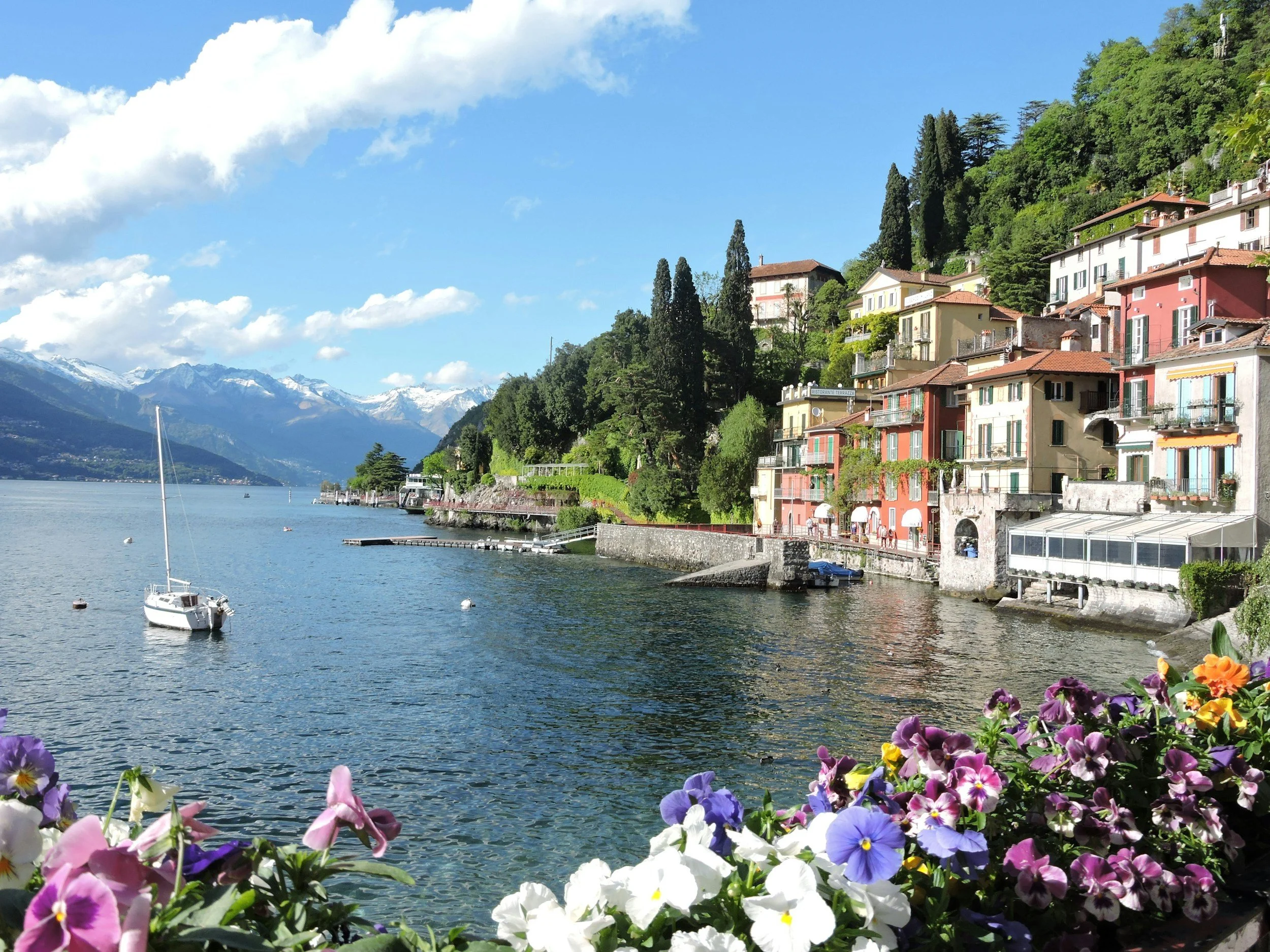
Varenna
Varenna, on the eastern shore of majestic Lake Come in Lombardy, is situated at the base of the snow toped Italian Alps. Varenna is a picturesque and charming village set in a Mediterranean climate of about 700 souls. This makes Varenna an ideal spot for you to recharge your batteries and get ready to explore the wonders of Tuscany. The town is not a check-off-town that once seen is removed from your list. Having just arrived please slow down letting the town and the lake set the pace. I thought it was at its best in early morning light and at sunset.
If you have been with us before you know I have a thing about boots. Flip flops are a no-no, as are fancy shoes. You will want to lace up nice comfortable boots. The ceilings are not cobblestoned but everything else is --- so be prepared.
We recommend 2 nights in Varenna, but we stayed 4 nights and left feeling rushed. Varenna is made up of the upper and lower town connected by a series of steep alleys.
The focal point of that last sentence was the word “steep” as in steep. Going down the alley you sing a little Puccini ditty. Coming up is all Wagner and deep-throated Brunhilde (about 200 steps).
Things to see and do in Varenna
If you’re only there for 2 nights just rest and enjoy the beautiful town that is made for walking.
However, if you’re up to it there is ever so much to do.
12th century church of San Giorgio and the 15th century bell tower
Villa Monastero and gardens
Boat trip around the lake with stops at Bellagio and other lakeside towns
Villa Carlotta and gardens
Hiking trails and water sports
Castello di Vezio
TIP! Just a reminder: Consult Deed’s Guidepost, as well as our Essentials, on Packing, Pacing, and Clothing.
Florence (Firenze)
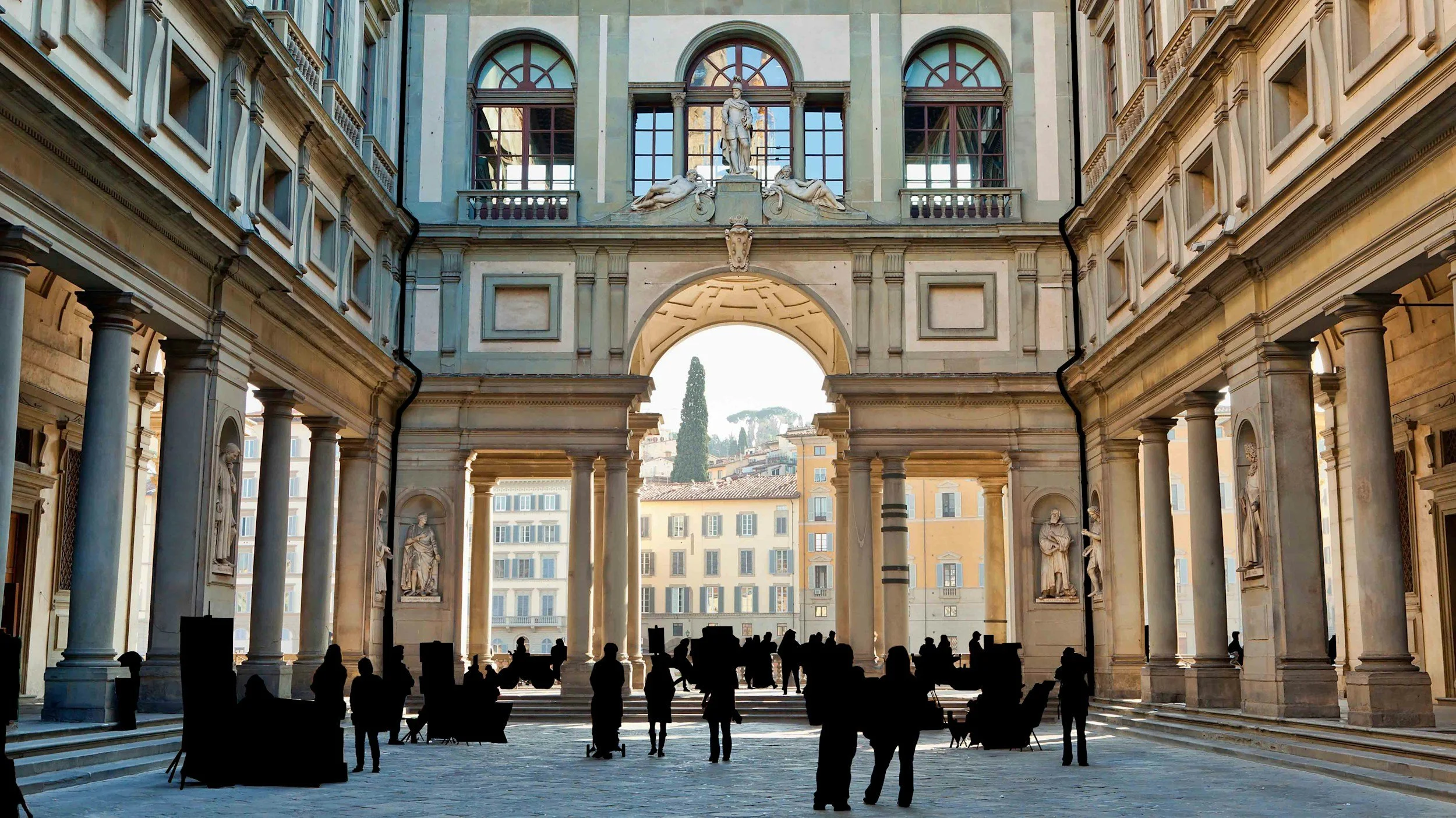
Uffizi Gallery
How long did you stay on Lake Como? Was it difficult to leave?
Now you’re off to your next adventure and Florence really will be an adventure --- an adventure for the senses.
If you’re like us the drive from Varenna will fly by in conversation and wonder of memories of the Como region.
The drive is about 5 hours with most of the drive on the autostrada with a cost of about €35+ and around 220 miles. There are many tunnels, viaducts and neat curves along the way, particularly when on lesser roads, so as always watch your speed, no phones while driving, and on the autostrada only be in the left lane when passing.
There are wonderful rest stops (Autogrill) on the autostrada --- they are helpful and interesting.
Florence (400,000) has limited driving zones (ZTL) in the historic district. Do not drive, I repeat do not, drive in the ZTL’s unless you have prearranged access with your lodging. You may want to leave your car in a garage outside the ZTL zone. Once in the city it may not be practical to use your car until you leave.
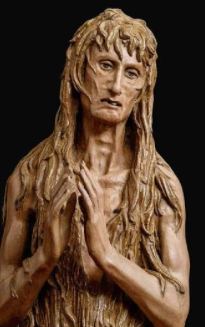
Please, if you see nothing else in Florence see Donatello’s Penitent Mary Magdalene. I wept when I saw it. It made me an emotional wreck, and to this day I remain in awe of the talent and spiritual insight that Donatello brought to the project. What I found was an aged barefoot woman with hands clasped in prayer.
Donatello’s Mary Magdalene is not at all what I expected to see. I was expecting to see a beautiful woman, some idealized version of seduction. What a wakeup call it was to see Donatello’s inspiration.
But there is more to see and do. Florence is exceptional.
You'll feel less pressure visiting Florence if you plan to come back soon. Deed estimates we've been there 14 times. Perhaps she’s right. We need to go back again.
So let’s agree to peel back the expectations by reviewing what you did in preparation for this trip. Remember, “Who are you? And “do well what you do and don’t try to do and see everything.” Florence is a museum so before you left home you needed to make a list of what you wanted to see and do. I hope you did that.
One year we traveled to Florence with friends who couldn’t care less about art. To them art was simply an object like a pair of leather gloves. They had a wonderful time because they were honest and knew what they liked and what was important. We often went our separate ways and met again over a late dinner. Together the four of us agreed that the other couple entirely missed Florence.
So know who you are and what you want to see and do.
By being in Florence you open the doors to the beginning of the modern world, a world of an age gone by, a humanistic world that began the slow turn from God to man and enter the world of Florence at its peak. It was the Renaissance.
A list of things to see and do in Florence:
The Accademia Gallery: Here you can admire Michelangelo's masterpieces, as he revealed the figures hidden within marble. With his David, and perhaps even more so with his unfinished Dying Slaves, Michelangelo showcased what sculpture could achieve. Unlike Donatello’s smaller, youthful David, Michelangelo’s version is large and powerful, depicted with a confident, head-held-high expression before battle. As for things to look for in Michelangelo’s David the head and hands are slightly oversized and notice how the hips shift the weight to one leg that is supported by what appears to be a root or stone.
In the gallery corridor are the magnificent unfinished Dying Slaves each in a different phase of completion as they seem to be in the process of emerging from the marble block of stone. Parts of the Slaves are polished and nearly finished, other parts rough and still in the process of being “created,” but never to be set free. Also unfinished is his St. Matthew.
The Renaissance flowered over many centuries, so you want to give special attention to the period of Giotto, Fra Angelico, and Cimabue the last great masters of the pre-Renaissance era. To us their work looks flat, stiff, and symbolic rather than realistic. But both paved the world to the Renaissance. You can readily see the development from Giotto to Cimabue.
Deed has hit the delete key and told me to move this along.
Bargello Museum: This former medieval palace is now a museum. Centuries back they enjoyed the not too infrequent playtime called war, so many palaces on the outside resemble a rock-solid stone fortress. Here you will find Donatello’s David and his St. George with many other statutes.
The Uffizi Gallery: This gallery has the most important Renaissance painting collection in the world and will likely be crowded so know what you want to see before you get there. A few suggestions include Botticelli’s Birth of Venus and Primavera, da Vinci’s Annunciation, and Caravaggio’s Medusa. But these are the obvious ones that everybody will want to see. A few of my favorites that are often neglected include:
Piero della Francesca --- Portraits of the Duke and Duchess of Urbino
Fra Angelico --- Coronation of the Virgin
Domenico Ghirlanddaio --- Old Man and His Grandson
Titian --- Venus of Urbino
Correggio --- Adoration of the Shepherds
Pitti Palace and the Palatine Gallery
Ponte Vecchio: Built in the 14th century, the current iteration of the old bridge across the Arno River that connects the ancient city.
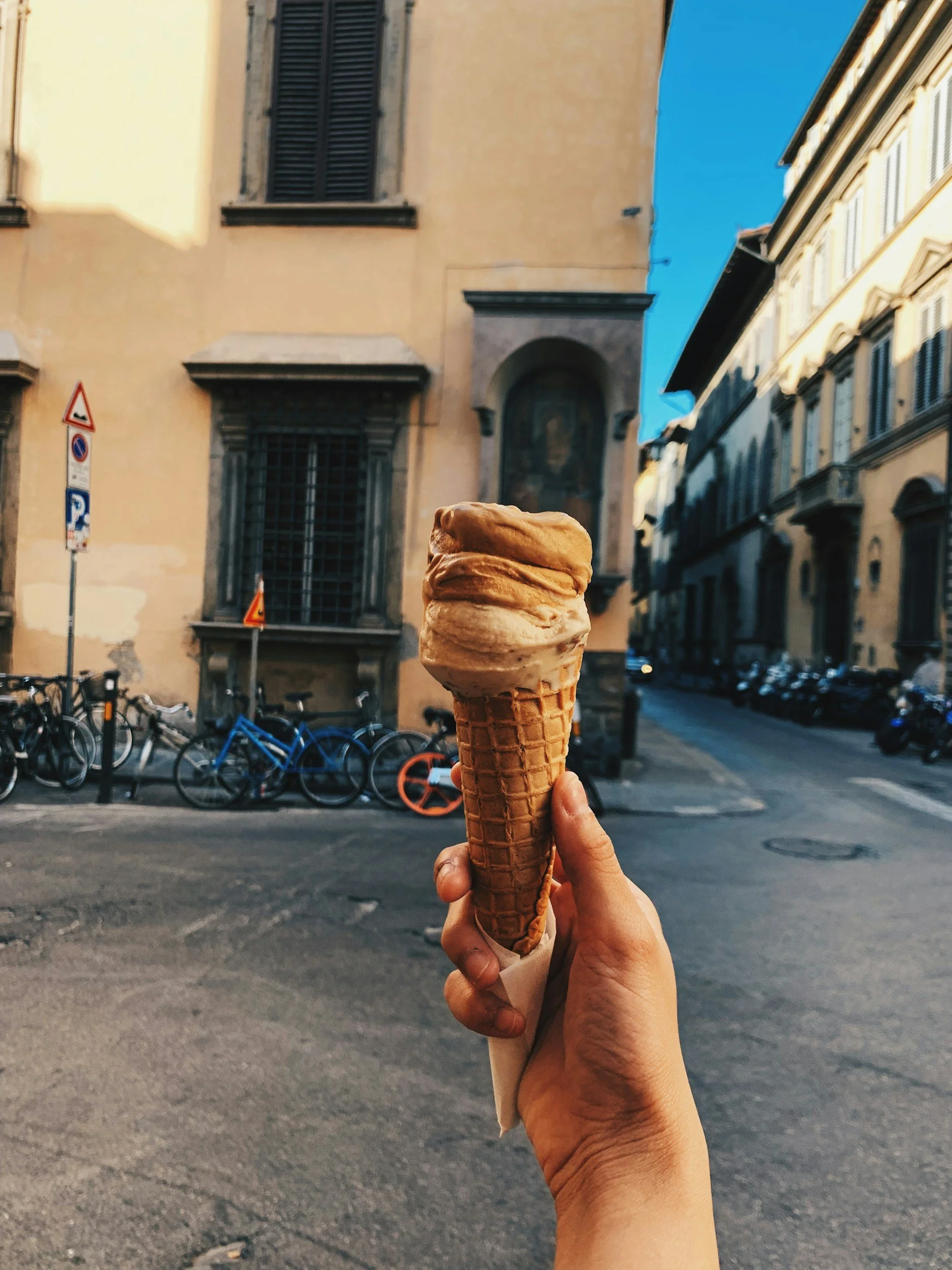
Gelato: Found everywhere in Florece, but the best is found at the Piazzale Michelangelo on a hill. It is a short taxi ride or cheaper by bus or cheaper still by walking about 30 minutes along the Arno with steps to the Piazzale. It’s a beautiful walk at sunset.
Duomo and Baptistery: The full name is the Cathedral of Santa Maria del Fiore. The Duomo was begun in 1296 and finished in 1436. Does that make you blink? The US is 250+ years. Almost all the people who began to build the Duomo never saw their work completed. The exterior is green, white, and pink marble. It is so massive it is best viewed from Piazzale Michelangelo with a bowl of mixed flavors of gelato. From the Piazzale the full scale, and the brilliance of Renaissance engineering is clearly visible in Brunelleschi’s double shelled Dome. It is, I believe, the largest masonry dome ever built. Located directly across from the Duomo is the octagonal shaped Baptistry dating even further back than the Duomo. The Baptistry has a number of doors but the most famous are the east doors of Lorenzo Ghiberti said to be “worthy of the gates of Paradise.” The original doors are now in a nearby museum and what you see on the Baptistry are copies. The10 panels depict scenes from the Old Testament.
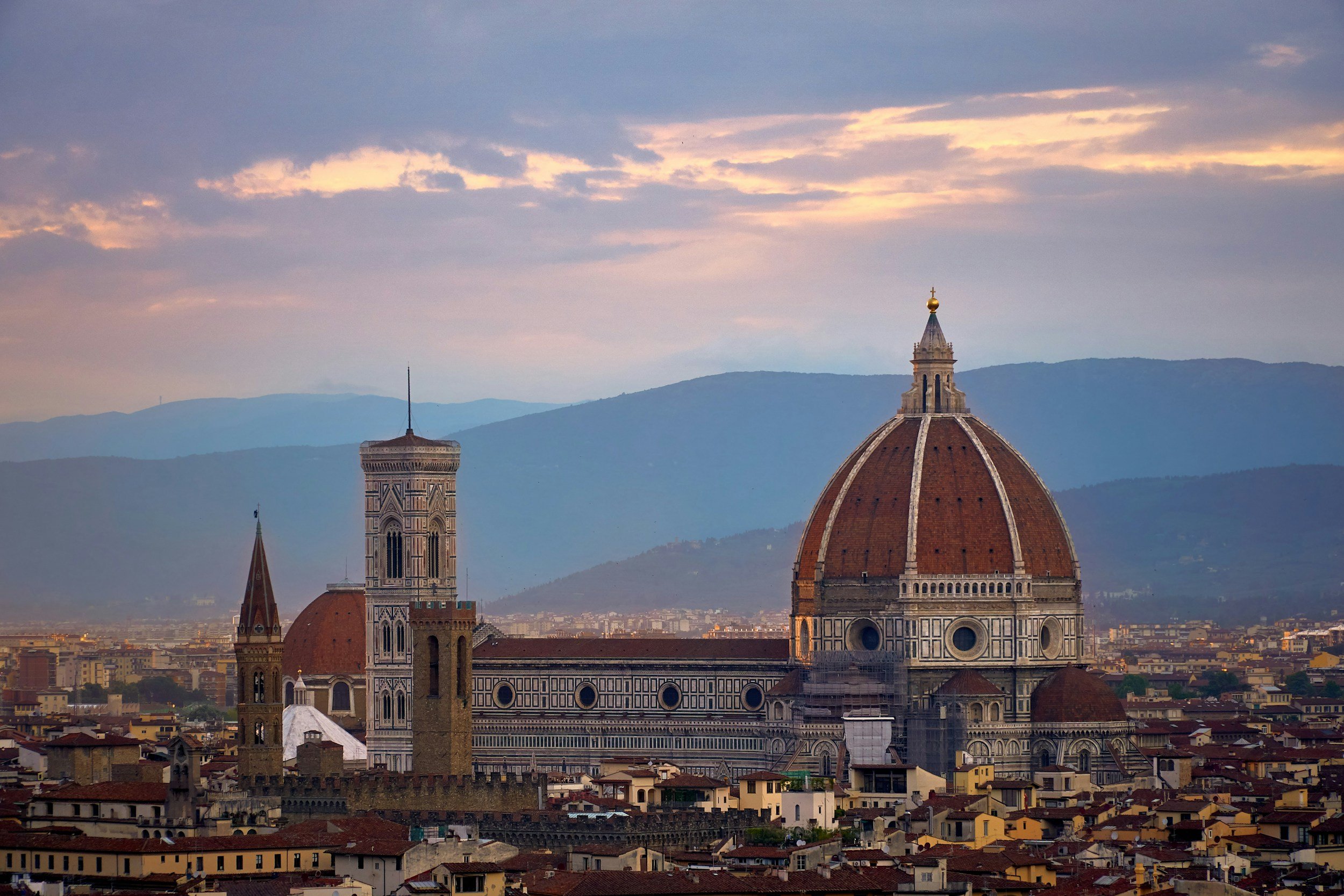
The Duomo
Let’s Catch Our Breath
Yes, Florence overwhelms. After five days in Florence I’m always exhausted. I’m exhausted both physically and mentally. Deed, on the other hand, would still be out buying leather gloves. Florence has stayed the spiritual and cultural center of the Renaissance and has set the tone for all of modern Western Civilization, but the pace can be a bit much.
TIP! We recommended 5 nights in Florence. So, who are you? Do you need more time? Are you planning to return to Florence? Remember, do well what you do and don’t try to do too much.
Time to Relax
When it’s time to leave Florence Deed has found two small Tuscan hill towns to restore your energy. The recommended towns are Montepulciano and Pienza. Both towns are in the wine region of the Val d’Orcia.
TIP! We recommend when leaving Florence that you pack your backpack with everything you will need for 2 nights and leave the rest of your luggage in the car. Check with your host to see if you can leave the car at your lodging. Not likely.
Montepulciano is about 70 miles south of Florence. The old part of town has a population of about 3,500 and is mostly a pedestrian zone so you will likely need to leave your car in a public parking zone. The old town is totally walkable and is centered around the Piazza Grande and the town hall (Palazzo Comunale). There are day trips into the Tuscan countryside to places like Lake Trasimeno or to the La Foce Gardens but likely you will stay in town and just enjoy the beautiful medieval streets and views of the valley.
Pienza is a similar yet different hill town with its quaint artisan shops and its famous pecorino cheeses. In both towns there will be cantinas for wine tasting and walks in vineyard landscapes. After Florence, the hill towns will enable you to slow down and smell the grapes.
TIP! We have recommended 2 hill towns, but you could easily select any from a long list of hill towns without being disappointed.
How about a Peep at the Mediterranean?
As I write this it’s late at night (8:15) and Deed’s fast asleep so I’m going to try and get this quietly past the editorial board while the getting is good.
How would you like to add 2-3 nights along the Tuscan coast? I’ve been pushing this with Deed for the last couple of weeks but so far without success. Yes, I’m being sneaky and underhanded. I plead guilty. But you’re sooooo close to the sea, and I say if there is time in your schedule that you might just want an Italian beach in your future.
I’ll keep this brief --- very brief. Castiglione della Pescaia (7,500) is primarily now a true seaside town with easy walking near the water, but its origins go back to medieval times and beyond. Naturally, like most hill towns, it has its own fortress above the upper part of town. There is a long promenade for evening strolls with sunset restaurants and nice benches to sit on and enjoy the sights and sounds in a relaxed atmosphere.
Plus excellent hotels.
In addition, you can enjoy a range of activities like water sports, biking, and boat tours. The beach is also available.
Now, let’s see if Deed catches this!
Siena
I really don’t think Italians watch much TV. They all seem to be dining out each night, strolling the streets, bunched together in cafes having coffee and pastries, or finishing off a triple gelato.
In Siena’s Piazza del Campo, the living room of Sienna, that’s exactly what they all seem to be doing. I think it’s called enjoying the good life. At home I’m in front of a 65” flat screen. But I digress --- again. Sorry.
Back to Sienna. Siena is my favorite town in Italy. I could live in Siena because it fits like an old sweater. Now when I speak of Siena (55,000) I’m really not speaking of the new modern section that surrounds the historic district. My Siena (20,000) is the Siena of the Middle Ages and the Renaissance with a proud history as an independent city state. Siena was rooted in traditions with a strong sense of community. It was situated along the routes followed by merchants and pilgrims, which accounted for their overall prosperity.
Since the 12th century Siena has famously been divided into distinct organized and fiercely proud neighborhoods. Even today Sienna is divided into 17 neighborhoods (Contrada).
During the Renaissance Siena struggled to keep its independence and would eventually fall to Florence, and later other more powerful forces, and not until the end of the 19th century did it, with other Italian states become part of a united Italy.
Things to do and see in Siena:
Piazza del Campo: The major square in Siena and nearby is the Palazzo Pubblico (town hall), important churches and other historic buildings. It was here, to our delight, that Deed and I spent most of our Siena evenings.
Torre del Mangia; one of the largest medieval towers in Italy
Siena Cathedral (Duomo)
The Contrada neighborhoods
Santa Maria della Scala (museum)
Restaurants and more restaurants
Teatro dei Rinnovati concerts, and plays
And seasonal events such as The Palio which is Siena’s famous bareback horserace
Decision time
In the comfort of your home you need to decide whether to head back to Malpensa Airport and go home or make your final stop Milan rather than Siena. Deed and I are in complete agreement. Our thinking is that Milan is a big city, too big, and an experience that tilts the entire Tuscan experience out of whack. Go home!
But this is your trip. You’re in charge. The historic center of Milan is truly spectacular.
Back to Malpensa Airport from Siena
Most of the trip to Malpensa is direct and on the autostrada. Leaving Siena take the A1 North passing near Florence and Bologna switching to the A8 near Milan toward Malpensa and finally following signs to the airport SS336, but most likely you will be guided by your phone or GPS. There are several car drop-off areas near the airport. Just follow the blue signs. Know which terminal you will be flying from. Your rental agreement might say which terminal and which car return location you need.
Finally, as with all our tour suggestions, the total number of days of your trip is for you to decide. In a lifetime of exploring we have never felt any of our trips to have been too long. You could easily add more days to this itinerary. Hint. Hint. This would make a wonderful 28-day
trip without changing any of the locations. Hint. Hint.
Hope to see you again soon.
Review our “We’re Glad You’re Here” entry, as well as Deed’s Guidepost and Essentials for detailed guidance on:
Counting Days and Budget
Packing
The Aging Process
Perspective and Pacing
Stress and Endurance
Car Rental in helping you prepare for your trip
Plan well, travel well, and savor the experience.