
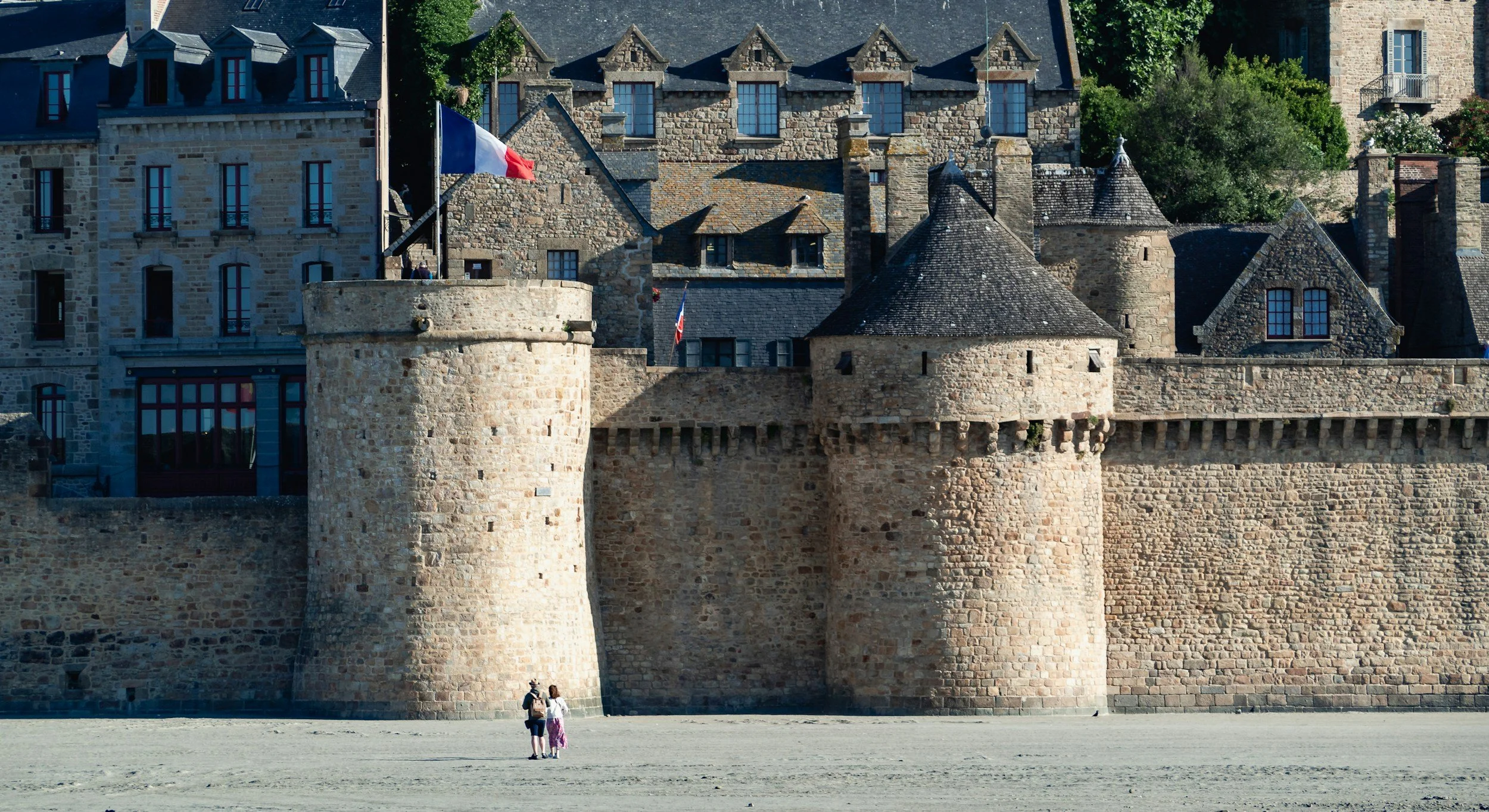
France: Normandy, Brittany, the Loire Valley, and Beyond, 21-28 Days
Welcome. If you have been with us before --- welcome back. We always welcome independent senior travelers seeking new adventures. If you are new to Independent Travel for Seniors then --- welcome.
France has a voice. It has sounded through the centuries with a clarity that has the ring of pride, perhaps even rebelliousness, that strikes many outsiders as being too proud. The French might reply that their achievements across all fields over centuries reflects not arrogance but simply a realistic assessment of France’s role in shaping Western Civilization.
Wherever you, the tourist, fall on that divide it is difficult to deny that France has had a voice. Has the voice been diminished in the 20th century? Most definitely.
The story of France is the story of her past. Sad, but true.
But you have come to France to see and understand France’s past glories and to try to understand her new course.
There is much to do so let’s get started.
Your Arrival at Charles de Gaulle Airport (CDG)
Most international flights arrive at CDG (Orly Airport also works and is nearly as convenient) but I assume that CDG will be your arrival airport. Arriving and clearing customs takes about 60-90 minutes and then follow the clearly marked car rental signs to all the major car rental agencies. Your decisions about automatic transmission, GPS, size and kind of car were decided at booking so you should soon be with wheels. On the continent I always order a manual because it is less expensive and I usually get a mid-size 5-door. Remember, always take pictures of your car at pick up.
Leaving CDG for the first 30 minutes there will be some serious traffic, but if you watched videos in the comfort of your home driving out of CDG will not be too stressful. Soon you will be on more open highways and heading out of the Paris/CDG region.
Vernon
Right off the bat I will need your input. We always stress how important it is that you know your limits. If you think you will be too tired to drive after your flight then it might be best to stay at an airport hotel and after a good night’s sleep pick your car up the next morning.
If, however, you’re good to go we suggest the town of Vernon (26,000) for about a 90-minute drive on mostly good roads from CDG. Vernon lies on the River Seine midway between Paris and the Normandy coast and will offer a most pleasant first night in France --- much better than an airport hotel.
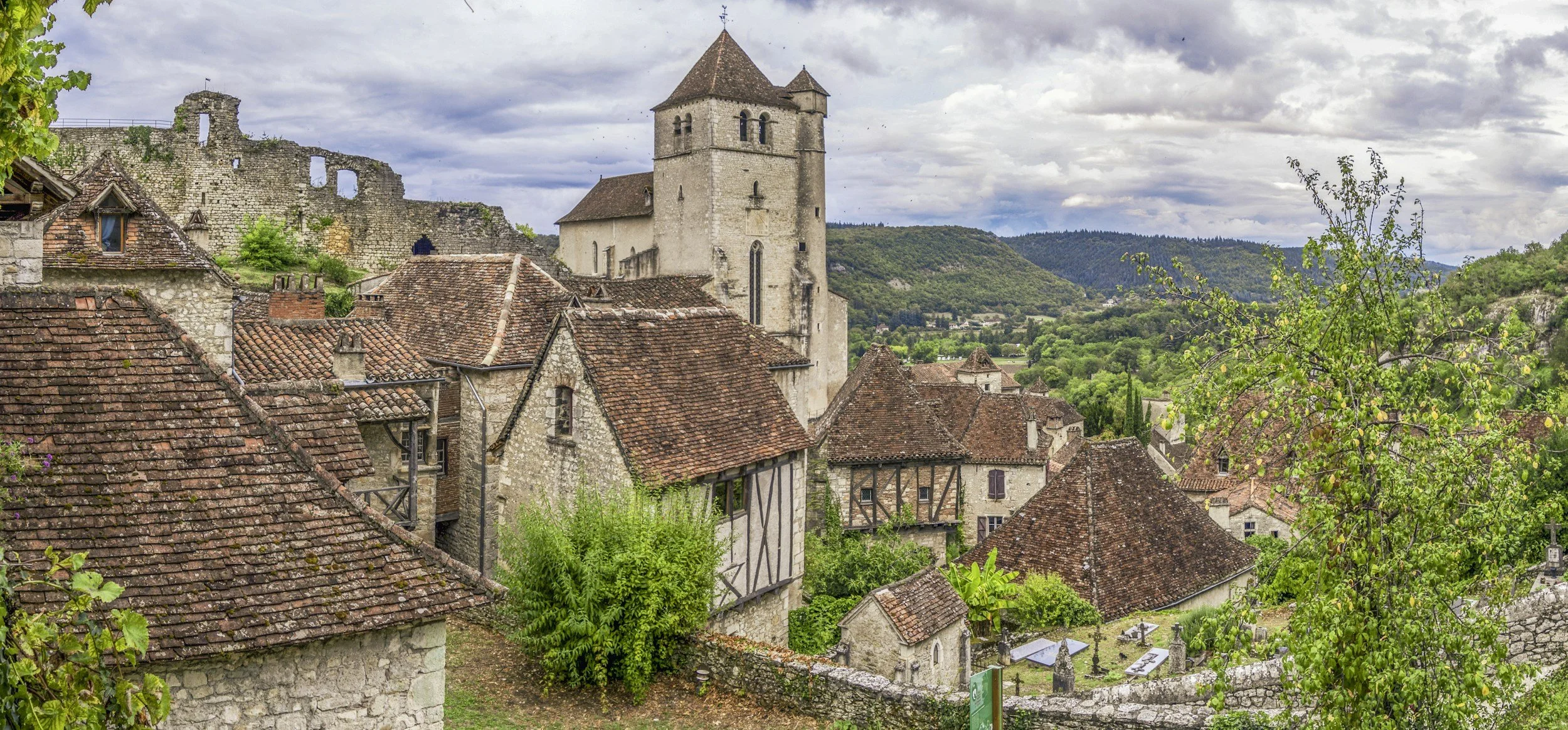
Vernon was selected purely for its convenience as a first night stop. It has a medieval charm of a fortified town central to ancient trade routes and occupied an important place in the political struggles between Normandy and the kings of France. After its was absorbed by the kings of France it became a royal town and part of the system of fortifications that secured Paris. I hope you will have time to see the Old Mill built on piers in the Seine, and perhaps the fort. But you are there to rest and get ready to explore the coast.
We suggest one night, but two nights might help. Your call.
Honfleur
The drive from Vernon to Honfleur should take you less than 2 hours with some traffic near Rouen during the rush hour but nothing to stress over. You will mostly be on the A13 with clear markings and good rest stops and as you near Honfleur you’ll be on more local roads. Getting to Honfleur early makes parking easier, and easier still if your lodging has a dedicated car space for you.
We loved Honfleur and hope to return again and hope you will feel the same way.
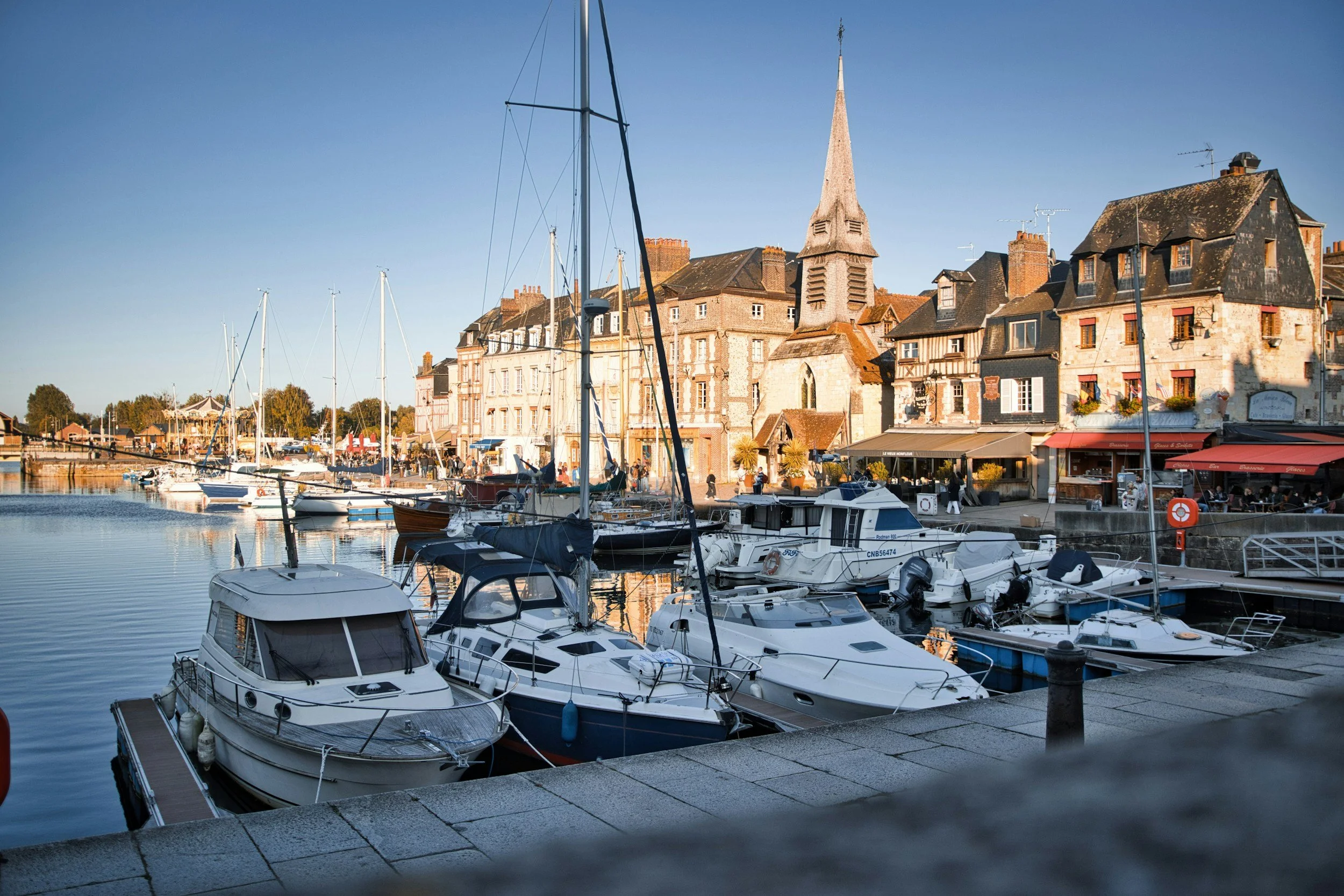
The historic harbor of Honfleur is situated where the River Seine meets the English Channel. Today the harbor is used primarily for pleasure boats but for centuries it was a working harbor where fishermen sailed forth to faraway places like Newfoundland. William of Normandy in 1066 used Honfleur in his conquest of England and later Samuel de Champlain sailed from Honfleur settling Quebec City and earned fame for France in discovering what became the St. Lawrence River.
Honfleur (8,000) is a walkable town with an old harbor and narrow medieval streets lined with delightful restaurants, shops and cafes that weave around the fantastic 15th century wooden church of Saint Catherine.
It is the largest wooden church in France. With an abundance of shipbuilders and seasoned oak Honfleur turned to its shipwrights to design and build the church based on naval engineering. From the interior looking up the church looks like an upturned ship.
We recommend a 3–4-night stay in Honfleur and you might consider an apartment in the old town near the harbor or one of the lovely B&Bs that offer a chance to meet some of the locals.
Honfleur requires attention and should not be rushed. Its charm is part of the reason that Honfleur is considered the birthplace of French Impressionism. It was here that French artists decided to leave the studio and to seek the light of Honfleur. Monet often used Honfleur and its harbor and buildings like Saint Catherine’s for his subject.
Things to do in Honfleur:
Maritime museum
Impressionist museum.
Walk around the town and harbor.
Seaside walks along the beaches and the promenade.
Shop interesting local shops and markets.
Tip: First, the museums are gentle and will not exhaust you. Second, Honfleur demands depth of understanding. Think about the artists who came for the “light of creativity”. Almost every street is a painting. The harbor is a painting. Saint Catherine’s has been immortalized by Monet. See Honfleur in early morning and at sunset from some small café.
Also, if you are a history buff you may want to incorporate some of the D-Day landing sights on your way to Saint Malo. Omaha Beach and the American Cemetery at Colleville-sur-Mer is one of the most important and moving experiences in all of Normandy. Note: Deed took a number of small bottles to Omaha Beach and filled them with sand from the beach to give to some of our older friends who had a special relationship with the beach and the war.
Deauville, Saint Malo, or Both
Your decision. We will try to help you but may end up only confusing you. Sorry!
For us, that means Deed, it was an easy call. Deed was not packed for Deauville, so we did not go to Deauville. Let me explain. Deauville is a high-end shopping-casino-bathing resort for the rich and famous who want to display all their toys and to meet for lunch to watch the ponies run and then gamble away the night. Deauville needs to be a commitment to an entirely different wardrobe and a very different set of activities. If you can do it then go for it.
But for us, we kept our boots on and went to Saint Malo.
Saint Malo
For such a small fishing village Saint Malo just drips with historical significance. Shaped by the Atlantic with direct access to the English Channel (La Manche, the sleeve) Saint Malo exists because of its physical setting. It is perched on rocky outcroppings of granite that have been turned into a walled fortress. It’s natural harbor and extreme tides turned Saint Malo to the sea. The fishermen of Saint Malo were some of the very first (perhaps as early as the 1460s) to explore the Grand Banks off Newfoundland and what would become New France.
The fishermen of Saint Malo were some of the first to come into contact with the natives of North America. The fishermen built “salting stations” to salt and dry the cod and to return home with their holds filled with salted cod.
The ships of Saint Malo were modest, 150 tons or less, with crews from 30 to 80. The voyages of over 3,000 miles might take from 3 to 9 weeks with several voyages a season guaranteeing that the men were at sea nearly 7-8 months a year.
For your trip to Saint Malo we recommend 6-7 nights. I sense you are about to shut me down --- but hear me out. Deed is right on this.
Tip: You will have no trouble finding quality lodging but make certain that your car also has a place to rest.
So, let me explain. First, at some point during your stay you will be packing your backpack for a short trip by ferry from Saint Malo to Jersey, one of the Channel Islands (a Crown Dependency of the UK). Deed recommends 2 nights, but you could make her smile by staying 3 nights.
Tip: Leaving Saint Malo, France and going to Jersey, UK is easy. Customs is almost a wave of the hand and a smile.
More on Jersey later. Back to Saint Malo.
Saint Malo is a walled city and very walkable. Walking the ramparts that encircle the town takes about an hour, so they say, but it took us more than 2 hours with all our starts and stops. Today it feels more like a seaside town than a town of adventurous fishermen and pirates.
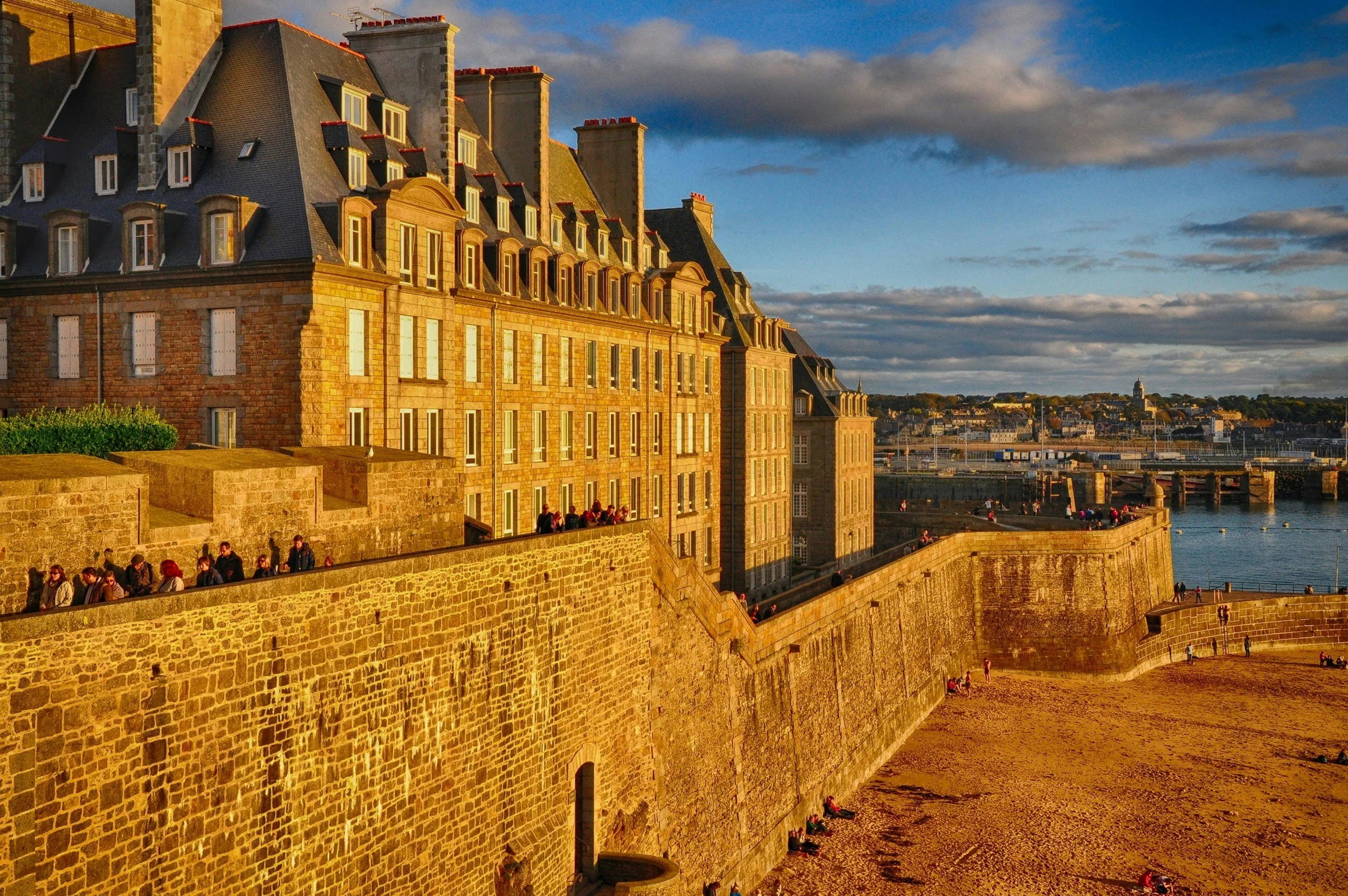
Saint Malo
Things to see and do in Saint Malo:
Walk its cobbled stoned streets and the ramparts. The city was rebuilt after much of it was destroyed in August 1944 by Allied bombing raids and remarkably restored to its original appearance.
Tidal walks to Grand Bé Island where the tides totally change the landscape from high to low tide. Don’t get stranded!
Castle and Museum
The Cathedral of St. Vincent
Jacques Cartier’s House
And enjoy some of the best food in France including crepes and galettes.
Plus, Mont Saint Michel is only a short drive away and is one of the most amazing sights in all of France. Henry Adams, the grandson of John Adams and the son of John Quincy Adams, wrote Mont Saint Michel and Chartres which has become a world classic.
The book, originally meant to be published privately, is a study of medieval civilization and the importance of the Virgin Mary and spirit of Christianity in defining the age. Certainly the book is one of the greatest achievements of American literature. The book would make a wonderful travel companion.
Leave early in the morning and allow 1 hour to drive on good roads and at least 4-5 hours to explore and experience Mont Saint Michel. It is one of the most astonishing achievements of man and may not be surpassed in all of Europe. Mont Saint Michel sits on a small tidal island of granite. At low tide the island is surrounded by sand caused by the receding tide, but at high tide it becomes an island totally surrounded by the sea. High up on the island sits the 10th century Benedictine Abbey with its three stories of cloisters built into the rock, and at the very top a statue of the Archangel Saint Michel.
There is nothing better than having Henry Adams as your companion when visiting the Mont.
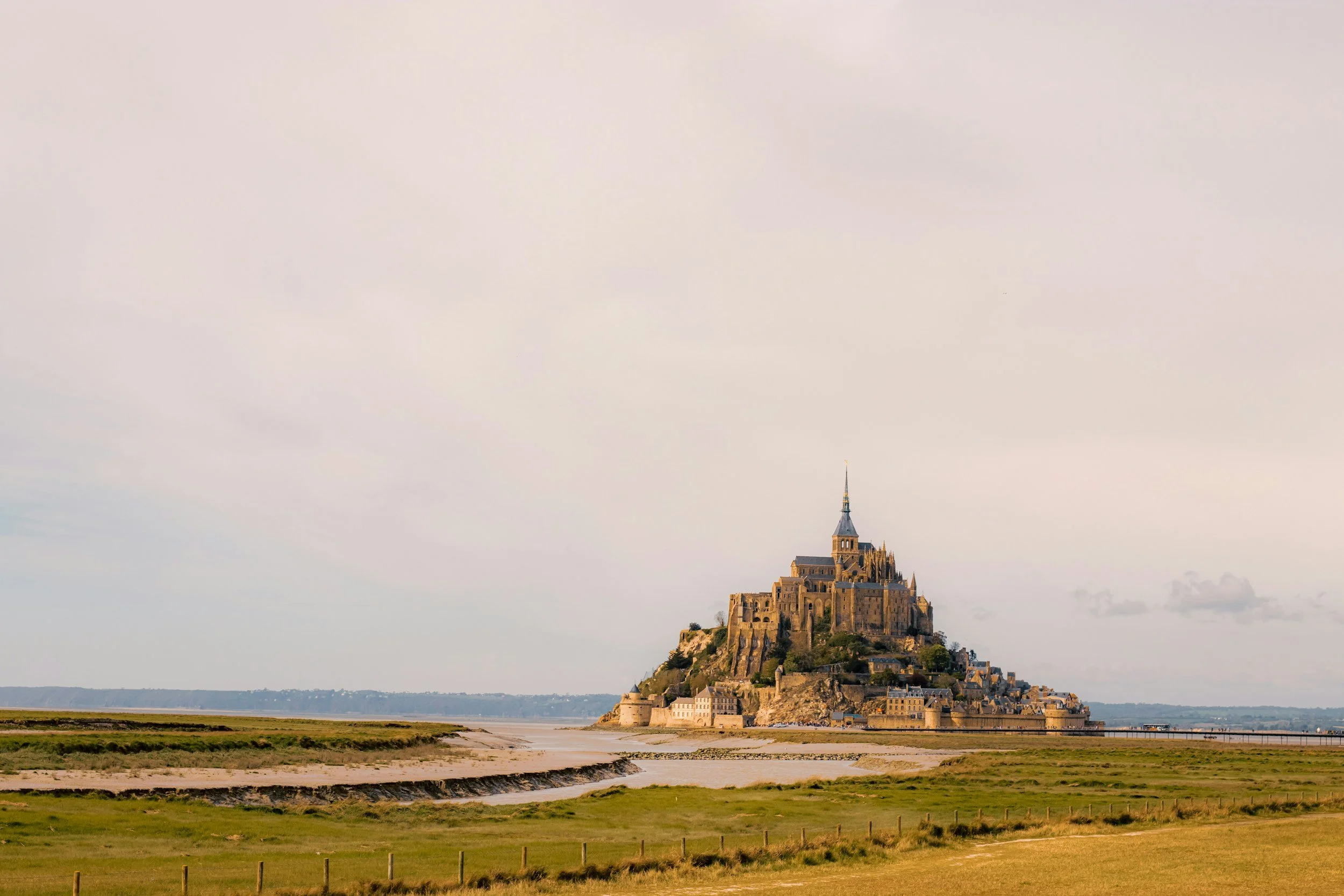
Mont Saint Michel Abbey
Jersey
It is from Saint Malo that you take the ferry or a short trip (8 miles) to the capital city of Helier on Jersey, the largest of the Channel Islands. We recommend a full day trip and returning on the late boat back to Saint Malo --- but in your preparation you may very well have planned to stay 1-2 nights. Good decision. Or, how about this? Rather than changing lodging take two day trips to Jersey. That works for us. The ferry boat is a lovely trip and just adds to the overall adventure.
Like Saint Malo, Jersey was a fishing culture with similar sailing routes and similar results. And today, like Saint Malo, the Jersey economy is primarily centered on tourism.
During the Second World War the Channel Islands were occupied by Nazi forces and not liberated until the end of the war. It was the only British territory occupied by Germany.
Things to see and do on Jersey:
St. Helier is basically a flat town offering pleasant walks and an attractive waterfront promenade. The town has narrowed streets of shops, restaurants, local museums, and an important war museum.
Rent a car and tour the very small island to see the lighthouse, rugged cliffs, beaches, and other island villages --- or go by bus.
Explore the war tunnels
Tip: Things to see and do are sometimes a little tricky. Places on this trip are simply experiences. When you go to Berlin there are things to see and do. In Honfleur and Saint Malo just be there and soak in the atmosphere and visually enjoy what you are seeing is the thing to do. Yes, that means slow down and have another glass of cider.
When you’re ready let’s go to Dinan.
Dinan
The drive to Dinan (11,000) from Saint Malo is easy and straightforward with no major traffic and it is only about 20 miles so you will get there before the car gets warmed up. Dinan is an attractively preserved medieval town with a history that dates back to the 10th century. With such a long history Dinan will certainly have a set of local heroes, legendary battles, and conquests to interest the traveler, but most of all Dinan is visual. During parts of the Hundred Years’ War it was under English domination, and during the Revolution was mostly sympathetic to the king and church and now it clings to its past.
Many towns in Brittany were severely damaged in World War II, particularly during and at once after D-Day, but Dinan was very fortunate to have only minor damage during the days of liberation from German control.
Our recommendation is that Dinan offers you an excellent base for 4-5 nights. It is a town to be absorbed slowly because its medieval half-timbered architecture offers a feast for the senses. We were most impressed with the multi-colored shades that highlight the old houses and in particular the use of blue.
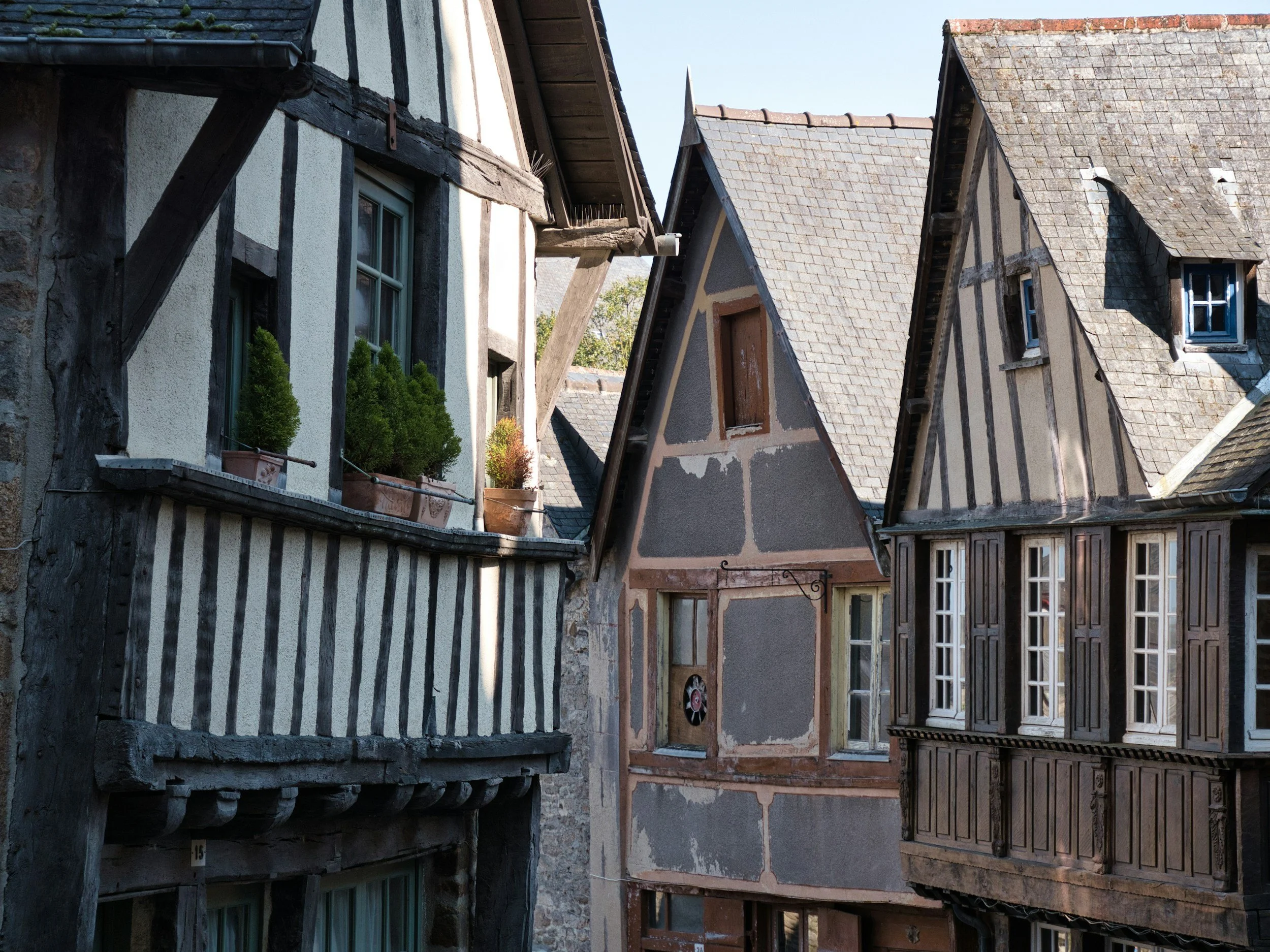
Dinan for centuries has been a fortified town enclosed by walls (ramparts). In Dinan the ramparts are wide enough to walk along and high enough to offer a stunning view of the town and the countryside.
Dinan was a port town on the River Rance and a fishing and trading center. Today the harbor is mostly used by weekend sailors. The business of Dinan today is tourism and if possible we recommend, as usual, going during the off-season.
Tip: The best thing to do in Dinan is to throw the list of things to see and do away and just enjoy this fabulous town. Just wander the old town and its famous Rue du Jerzual and the lower harbor. But I know you must have a list --- so here it is.
Things to see and do in Dinan
Walking the ramparts takes a good part of the day. It is about a 2-mile walk atop the ramparts and with frequent stops to take in both views of the town and the opposing countryside it might well take you 4 hours or more --- much more if you come down for a glass of cider.
River tour boats
Château de Dinan is a 14th century fortress with a well-preserved keep
The English Garden
The 11th century Saint Sauveur Basilica
Saint Catherine Chapel
Rue du Jerzual is a steep street of shops leading down to Dinan’s lower harbor
Walk or boat the river
The Place des Merciers
The town Market (Thursday)
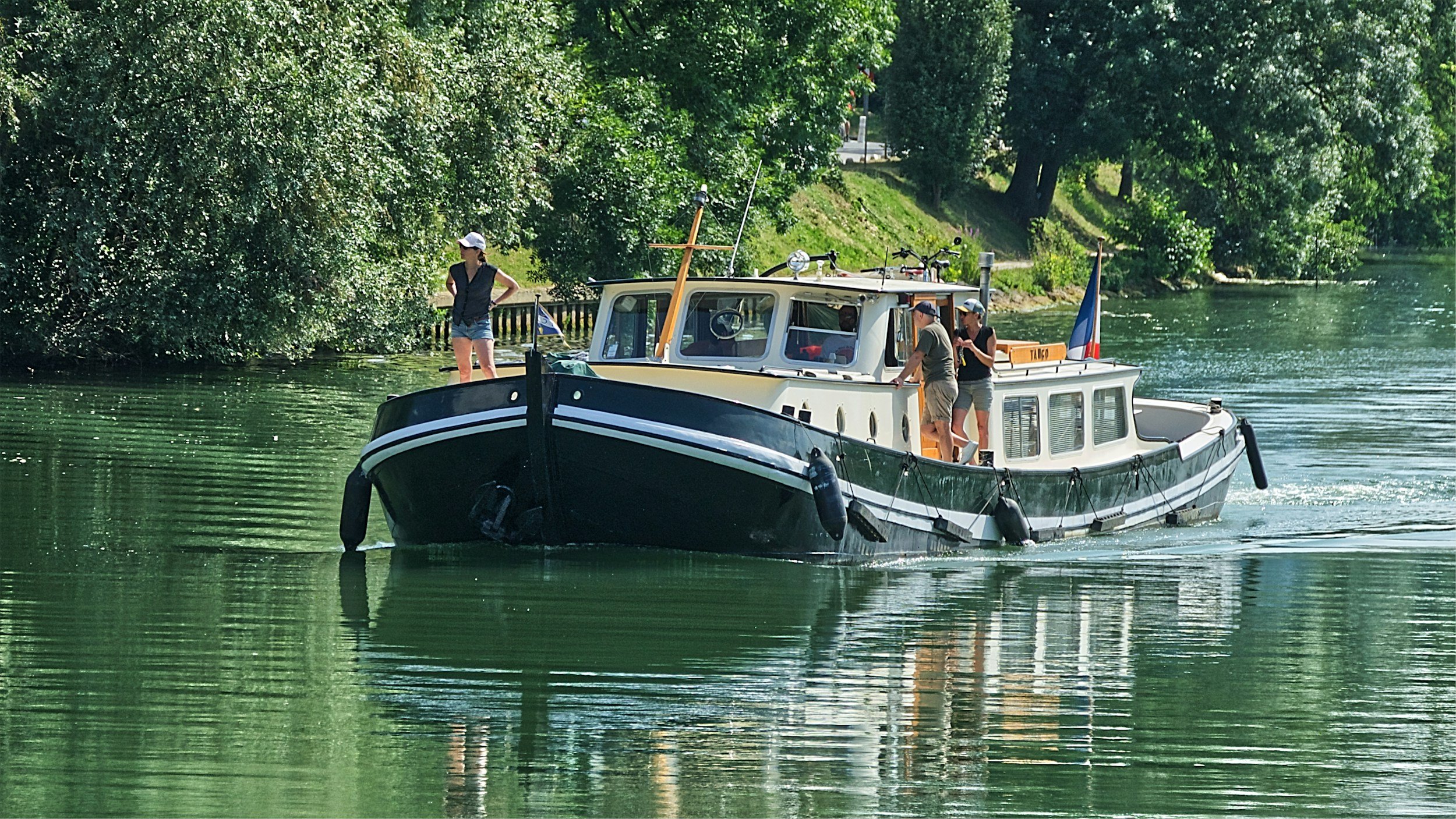
NARROWBOATS for hire --- COME BACK! I’M SERIOUS!
Along with another couple Deed and I rented a narrowboat for an experience of a lifetime that can only be described as piling fun on fun. Truly a dream trip.
What are the hazards? Basically none. You can’t get lost at sea. You can’t get hit by a storm. There are no navigational issues, and you poke along at about 4 miles an hour. And you just go straight, and you need no sailing experience.
The narrowboats are similar to a Winnebago without wheels. But it was much more fun. At night we stopped at small villages to explore and enjoy a riverside restaurant with the boat docked just steps away. And it’s likely you can rent bikes to ride the towpath or explore inland.
That is something for you to really think about and build into your trip before you leave home. April to October is the reliable narrowboat season.
Changing Point of Interest
To this point you have been in the France of walled medieval fortress-like towns. The towns reflected the unity of Christian faith throughout the Middle Ages, and the towns were also all influenced by fishing, trade, and commerce. Even as the centuries passed they generally kept their medieval aura even into the 21st century.
Now as you prepare to leave Normandy and Brittany you also prepare to enter a different France.
This new France is one of royal power. This new France is one of opulence.
In Preparation for the Loire Valley
After the Hundred Years’ War (1337-1453) fought between the kingdoms of France and England both countries were exhausted. Despite the name it wasn’t one continuous battle but a number of starts and stops lasting 116 years. It started over the king of England laying a dynastic claim to the French throne, but the French nobility preferred their own and selected Philip IV. Other causes of friction were disputes over English controlled lands in France.
Both sides being reasonable and conciliatory then went to war for over 100 years. For historians one hundred years had a ring to it, and it seemed silly to call it the 116 Years’ War so there you have it.
Here’s where Joan of Arc enters stage left and in 1429 inspired the French forces to victory. The outcome was that England lost most of its French territories, and a more powerful French monarchy appeared. The age of feudal wars was ending, and the rise of the strong nation-state was appearing. Hence the age of chateaus and the end of the castle/fortress.
The Loire Valley
Leaving Dinan on your way to Langeais you will have a very manageable drive of less than 4 hours and about 190 miles with a couple of pleasant stops along the way. Most of the drive will be on well-maintained roads and often you will be on divided highways so the stress level will be about a .02.
You will have little trouble booking lodgings in Langeais and most will be in easy walking distance to the chateau. Your choices are almost endless but please book early.
We recommend 2 nights so when you leave Dinan it makes it much easier if you just pack your backpack and leave most of your stuff in the car. This is doubly helpful if you book an inn or a B&B.
No sooner do I say you are finished with medieval fortresses than the next chateau looks a lot like a fortress --- but a pretty fortress.
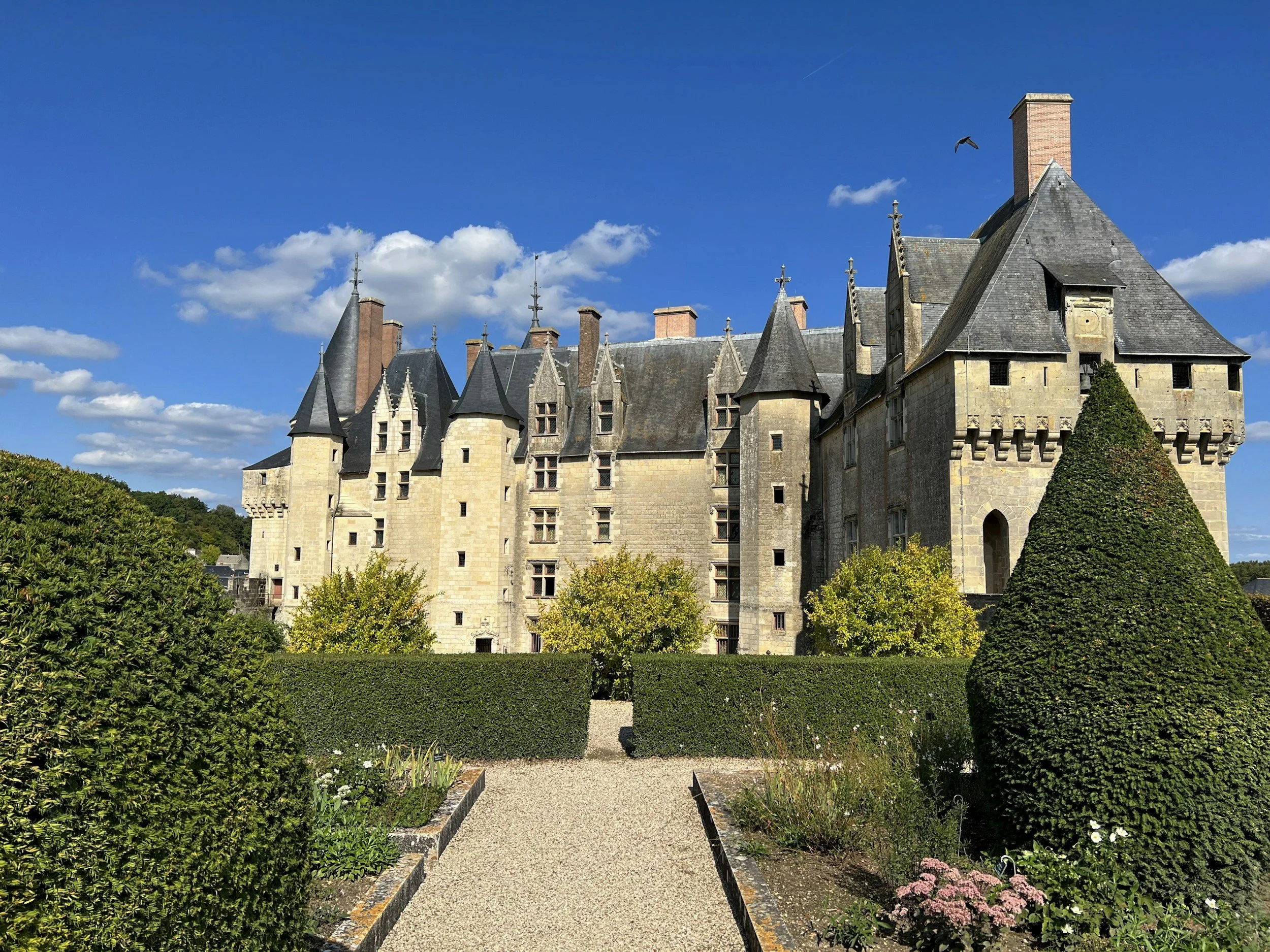
Chateau de Langeais
The small town of Langeais (4,000) on the Loire River surrounds its famous chateau of the same name. The chateau began as a fortified site in the 10th century but in the late 15th century evolved into an important and opulent Renaissance chateau.
The chateau played a major role in the unification of France. It was here that King Charles VIII married Anne of Brittany uniting Brittany and France and a major step in the unification of France.
Over the centuries the Chateau, as a fortress, guarded the Loire River but today it only casts a romantic shadow over the valley. It is open to visitors and offers a number of spectacular decorated rooms to visit with large tapestries depicting great events including Alexander the Great, Ceasar, King Arthur, Charlemagne, and others. There is also a reliquary room housing church relics and original works of art.
Outside the ground opens to wonderful gardens and walkways.
Tip: It seems to me there are two distinct levels of travel. The first is simply to go see something. The second level is to do your homework before you go and know what it is you’re going to see.
Saumur
The drive from Langeais to Saumur (27,000) is only about 25 miles with no major traffic or highways and will take you less than an hour. We took the route closest to the river and found it a most pleasant drive. Saumur is another backpack stay of 2 nights with any number of quality lodgings to choose from but lodge in walking distance to the Chateau.
If you have time on your drive to Saumur you could spend a few hours at the 15th century Chateau Montsoreau, a less military-looking chateau which sits on the Loire River and adds one more distinct chateau to your collection. It offers a pleasant riverside setting with easy walking. The only negative is that inside it houses a collection of modern art --- so walk the village. The village is very pretty.
The Plantagenets
As you enter the Chateau you enter the world of the Plantagenets. The royal House of Plantagenet was a French noble family that ruled England from 1154 to 1485. The Plantagenets controlled a great amount of land on both sides of the English Channel and controlled more of what we think of as France than did the French king. That included Saumur, the Loire Valley and Aquitaine. The dynasty began with Henry II of England and his marriage to Eleanor of Aquitaine. Their son was the hero Richard the Lionhearted and the three were buried in the nearby Abbey of Fontevraud. Their tombs were desecrated by the mobs during the Revolution.
Deed just pulled the plug on my history lesson. #%^&&**^%
Things to see and do in Saumur
The Chateau of Saumur shows the power and beauty of France.
The Abbey Fontevraud (not in Saumur but only about a 20-minute drive away and a most important part of your trip).
Walk through the historic center.
Riverside promenade.
Visit one of the limestone storage caves for Loire vineyards like Bouvet-Ladubay, Ackerman, or Langlois-Chateau.
Cadre Noir (Black Flame) is a significant institution for training the French military cavalry. One of the most respected riding academies in the world.
Tip: Actually more of a suggestion. Since Langeais and Saumur are separated by only 25 miles you might want to use one town as your base for 4 nights and just go back and forth. Think about it.
Amboise
The drive from Saumur to Amboise (14,000) is about 90 minutes (50 miles), and is an easy straight forward drive, and an even better drive, if longer, is to have your GPS take you via a more rural and scenic route by going through Montsoreau and Chinon.
In Amboise we cross over into the heart of the Revolution, and it is also a crossover as France transitioned from a feudal to a more elegant Renaissance court lifestyle.
Tip: How we planned the trip. Always back to “Deed’s Guidepost” and her conviction that we should see well what we see and try not to do too much. There’s a basket full of chateaus in the Loire Valley and to try and see too many turns any trip into just checking boxes and soon they all become a blur. So we have selected only the number that can be really experienced on a short trip. But always do what works for you. There is easily a dozen more chateaus that you can visit.
Things to see and do in and around Amboise:
Walk the old part of town. Amboise, situated on the Loire River, is not a typical medieval town like Dinan. Certainly there is a medieval subbase to the town, but it is rather a Renaissance royal town with Renaissance townhouses of the nobility and even some beautiful half-timbered houses. It even has a strong 19th century flavor that seems, to me, to be a distracting add on, but you will find pleasing shops, restaurants, and excellent lodging. Have no fear --- I will never recommend a town that does not have a creperie or a chocolatier.
Rue National is a pedestrian zone as are other narrow streets making the town walker friendly plus there is a lovely riverside promenade.
The pale golden limestone royal residence sits above the top (the town and chateau remind me of the Cotswold golden limestone --- Deed says it’s white not golden). Inside you will find beautiful rooms influenced by the Renaissance king Francis I and outside spectacular gardens that look down on the town and the private gardens of the town folk.
Clos – Lucè the house provided by Francis I to Leonardo da Vinci during the last years of Leonardo’s life. A must see.
A short drive away
Chateau de Chenonceau (35 minutes)
Vouvray wine country
Versailles
The drive to Versailles is about 150 miles and will likely take you about 3+ hours but we have another recommendation and that is that you should first stop in the cathedral town of Chartres. A stop at Chartres would go a long way in completing your Henry Adams experience so brilliantly detailed in Mont Saint Michel and Chartres. You’re so close --- and it will round out your medieval experience.
The drive from Amboise to Chartres is about 1 hour 45 minutes so you can easily devote 2-3 hours to the cathedral and have lunch in the town before continuing on to Versailles. Check out the cathedral on the internet before you say no.
Upon arriving in Versailles check you and your car into booked lodging.
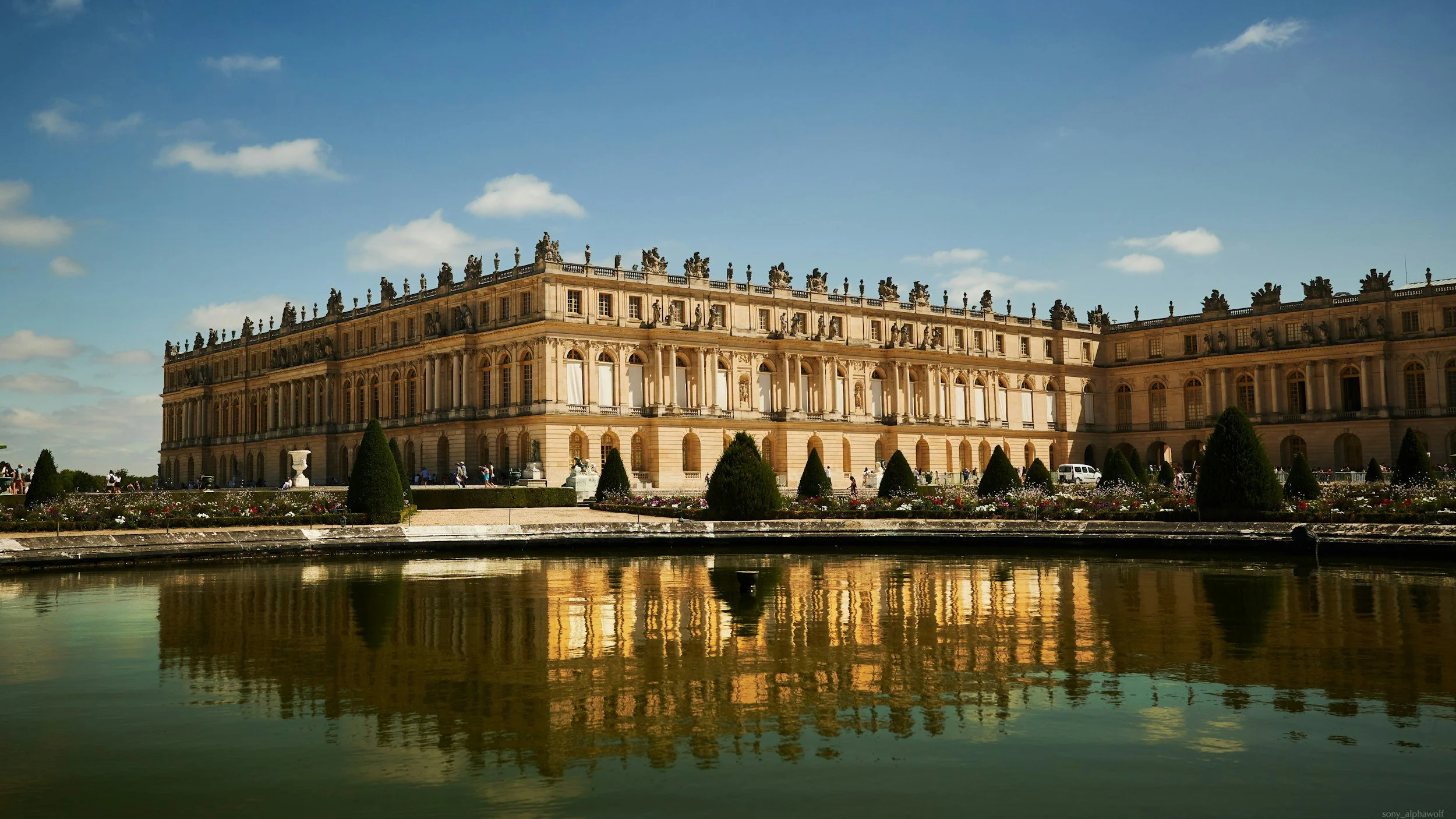
The palace of Versailles is a stunning example of the meaning of “absolute monarchy”. The palace was more than a royal residence, it was a set of apartments for the nobility, the national treasury, the war department, a barracks, a church, a theatre, an embassy, and much more. The palace kitchens prepared thousands of meals each day and the stables kept hundreds of horses plus numerous carriages. Then there were seemingly endless acres of gardens and parks. And then there are the fountains.
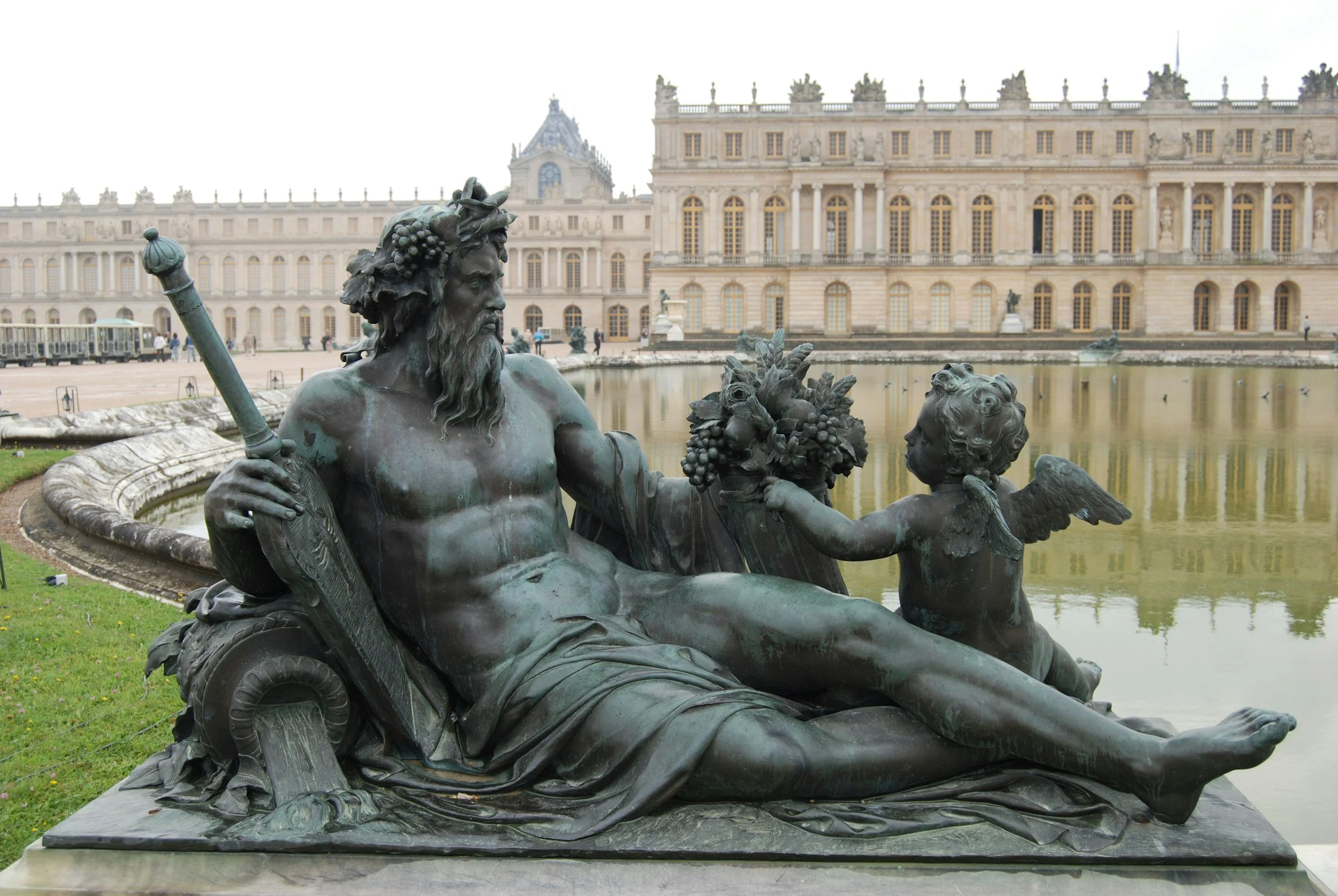
To this point your trip has been on or surrounded by water. Versailles has little water naturally and required great feats of engineering to bring water to the site and even greater engineering to run the 50 major fountains that dot the landscape.
To supply water for the fountains giant reservoirs had to be created, rivers had to be redirected and pumping systems had to be developed, still to the frustration of Louis XIV there was never enough water.
Deed is about to pull the plug on my ramblings but let’s try this. Before you go to bed at night weigh the clothes you wore around the house today. Were they summer things? Winter? What did they weigh?
A women’s summer clothing at the court of Versailles could weigh as much as 35 pounds. The fabric was heavy (seldom washed), and her wig could be 14” or higher. A man’s outfit would be about 25 pounds and just as pretty. Summers at Versailles were very humid.
Once you are settled in it is time to execute a plan of attack and there is no better plan than to plan that attack over a fine dinner in a selected restaurant.
So explore the town in search of a suitable restaurant. Take your time.
Versailles (90,000) is like no other town you have experienced on this trip. It was a designed town. It was engineered. There is nothing medieval about Versailles. To this point you have been travelling through a medieval and Renaissance world. Versailles is Baroque and designed to represent an ordered and controlled society. We recommend a 3–4-night stay but longer if it can be managed.
Things to see and do in Versailles
First of all arrive as close to opening time as possible. Remember buses from Paris loaded with tourists are on the way. In the palace on your first day, if you go on your own, you are likely to see:
King’s State Apartments
Queen’s State Apartments
Hall of Mirrors
Royal Chapel
Gallery of Battles
The next day you may possibly want to take a guided tour and gain access to the Opera house and behind the scene tours that are often closed to the general public. We have never seen the kitchens, staff quarters, or private apartments. It seems to me that the French government is taking forever to get the palace fully restored, but maybe that’s their plan. I can’t imagine that much more than 10% has been restored since the revolution.
Our last time, in order to better see the immense grounds, we rented bikes and loved our day exploring far beyond what you would expect to see in one day. We highly recommend biking Versailles --- both town and palace. We saved walking for the next day when we knew what to look for.
We divided out time by allotting most daylight hours to the palace and its grounds and evening hours to the town.
The Grounds of Versailles
The grounds of Versailles, to us, were more amazing than the palace. I have tried to imagine, without much success, what it must have been like during the reign of the “Sun King” when on a warm summers night to have been present with thousands of nobles elegantly dressed wandering amongst the gardens and gushing fountains to the sounds of roving minstrels. Or to be there during one of the frequent fireworks displays or to sit in one of the outdoor amphitheaters for a play by Moliere.
We recommend that you budget 2 days to comfortably see the grounds. Also stick in some munchies in your backpack for an out-of-the-way treat.
Things to do beyond the obvious statued gardens, parks, woodlands, and water treats:
The Grand Trianon: Built by Louis XIV, about a mile from the palace, is a smaller palace but no less grand. Built of pink marble it provided a more private setting that enabled him to live a less courtly life. It is now open to the public and its rooms offer a wonderful glimpse into the royal life.
The Petite Trianon: Built by Louis XV in 1760s as a retreat for himself and his mistress Madame de Pompadour. Later Louis XVI encouraged Marie Antoinette to use it as an escape from a hostile court. The Petite Trianon has a unique set of architectural tricks to disguise size and shape. The rooms are smaller, more intimate, and less formal.
The Hamlet: A small artificial village where Marie Antoinette created for herself a pastoral retreat where she and a select few could pretend to live a “rural life”. In the hamlet there were thatched cottages, a mill, a farm, domesticated animals, kitchen gardens, and a lake that created the illusion of the peasant life. (On the inside, the thatched cottages were elegantly finished.)
Tip: Together these three require a full day.
In the town we focused on:
Marché Notre Dame --- 18th century market halls
Cathedral Saint-Louis de Versailles
Royal Stables (maybe equestrian shows available)
Potager du Royal (Kings Kitchen Garden)
Concerts at Royal Chapel or at the Opera House
It’s time.
It always happens too soon. Let’s be negative for a moment. The drive from Versailles to CDG can be done in less than one hour if you leave early in the morning. I don’t care much for stress, so we leave very early. Very early means before breakfast --- sorry. If you do not leave early rush hour could take 4 hours. So, skip breakfast!
Returning the car for us was a slow process so expect about 40 minutes. Why was it so slow? Who knows?
The drive to the airport was well marked, clear signs, and modern roads, but at rush hour the traffic can get a little hairy.
So what are we saying? Get there early.
Enjoy your memories. See you soon.
Review our “We’re Glad You’re Here” entry, as well as Deed’s Guidepost and Essentials for detailed guidance on:
Counting Days and Budget
Packing
The Aging Process
Perspective and Pacing
Stress and Endurance
Car Rental in helping you prepare for your trip
Plan well, travel well, and savor the experience.